
There’s something about photographing a festival after dark that trips people up. The lighting is unpredictable, everyone’s moving, and phone cameras that look brilliant in daylight suddenly struggle the moment the sun goes down. But night is exactly when a festival like Moon Festival comes alive: lantern-lit crowds, silhouettes against a full moon, the glow of a street party spilling into the dark.
We asked Chip Radoslavov, a documentary and fine art photographer known for capturing real, unposed moments at weddings and events across the UK, for his advice on shooting creatively after dark. Here’s what he shared, adapted for anyone with a camera (or a phone) heading to a moonlit event this season.
Stop Fighting the Dark, Work With It
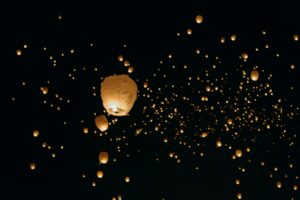
The instinct most people have in low light is to crank the flash and hope for the best. Chip’s advice is the opposite: let the darkness do some of the work. “Night events have so much natural atmosphere already, string lights, lanterns, the moon itself. A hard flash flattens all of that and turns a beautiful scene into a flat, overexposed snapshot. If you can, turn the flash off and let the ambient light shape the image.”
If you’re using a phone, that usually means switching to night mode and holding steady for the extra second it takes to capture the shot properly, rather than snapping quickly and accepting a blurry, underexposed result.
Use the Moon as a Compositional Anchor, Not Just a Backdrop
At an event literally built around the moon, it’s tempting to just point the camera up and shoot it on its own. Chip suggests thinking about the moon as one element in a larger composition rather than the whole photo. “A silhouette of a couple, a dancer, or a crowd against a rising moon is far more interesting than the moon by itself. Get low, get the moon behind your subject, and let the shape of a person or a group tell the story alongside it.”
This is the same principle that shapes his wedding portrait work: light and composition used to frame real people, not just render a pretty scene. A festival full of costumes, storytelling performances, and open-air crowds gives exactly that kind of opportunity.
Shoot the In-Between Moments, Not Just the Main Stage
It’s natural to point every camera at whoever’s performing, but Chip’s strongest tip is to look away from the stage as often as toward it. “The best images from any event, a wedding or a festival, are almost never the posed, expected shot. It’s the kid mesmerised by a lantern, two strangers laughing at a pub quiz table, someone mid-spin at a street party who has no idea they’re being photographed. Those are the images people actually keep.”
At a multi-day, multi-venue programme like Moon Festival, that means wandering between the scheduled highlights: catching the queue outside a storytelling performance, the quiet moment before a midnight run starts, the crowd reaction during a comedy set rather than just the performer on stage.
Slow Down Your Shutter, Carefully
For anyone shooting with a proper camera rather than a phone, Chip recommends experimenting with slower shutter speeds to capture movement rather than freezing it. “A dance floor or a street party has energy that a perfectly sharp, frozen image sometimes loses. A slightly longer exposure, even just a fraction of a second, can turn spinning dancers or swinging lanterns into something that feels alive rather than static.” The trade-off is a steadier hand or a small tripod, and a bit of trial and error to find the right balance between motion blur and a recognisable subject.
Get Close, Then Get Closer
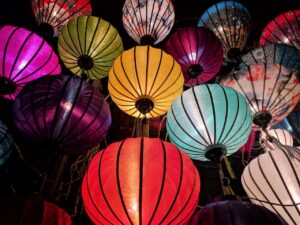
Wide shots of a crowd are useful for context, but Chip’s advice for anyone wanting more compelling images is to move in. “People underestimate how much a genuine expression up close beats a wide shot of a whole scene. At a festival full of costumes, candlelight, and real emotion, get near enough to catch a face properly lit rather than shooting everything from a distance.”
That closeness is also what defines his wedding photography approach: staying present enough in a crowd to catch real reactions without becoming a distraction, something that translates directly to any event with a lot of unscripted human moments happening at once.
Bring the Right Gear, But Don’t Overthink It
Asked what to actually pack for a night event, Chip kept it simple: a fast lens if you’re shooting with an interchangeable-lens camera (wide aperture lets in more light without needing a flash), a small battery pack since night shooting and video drain phones faster, and, if you’re serious about it, a compact tripod for the slower shutter shots. Beyond that, his advice is to spend less time adjusting settings and more time actually watching the event unfold.
The Real Takeaway
Chip’s approach to festival and event photography traces back to the same philosophy he brings to weddings: presence over performance, documenting what’s actually happening rather than staging what should happen. You can see that style across his portfolio at Lumen Atellier, where real, unposed moments take priority over stiff formal shots. It’s an approach worth borrowing whether you’re photographing a wedding, a street party, or a crowd of strangers looking up at the same full moon.